
What if you could secure your UAE residency or career advancement without the stress of flying back to Manila or navigating the Philippine Department of Foreign Affairs in person? Many professionals in Sharjah find themselves caught between tight visa deadlines and the fear of losing original certificates in a complex, multi-government workflow. We understand that managing Philippines document attestation Sharjah feels like a high-stakes administrative hurdle where one mistake can lead to costly delays. It’s natural to feel overwhelmed by the transition from the old red ribbon system to the current e-Apostille requirements launched in March 2026.
Easy Point Attestation Services provides this expert guide to help you master the complete legalization process for your Philippine documents with a focus on a hassle-free, end-to-end solution. You’ll learn how to navigate the 4-step chain, from obtaining a DFA Apostille to the final AED 150 MOFA attestation in the UAE. We provide a clear timeline for completion, typically ranging from 7 to 20 working days, so you can plan your future with confidence. This article outlines exactly how to achieve a validly attested document through a secure doorstep service that eliminates the need for personal visits to the UAE Embassy in Manila or the Philippine Consulate in Dubai.
Document attestation is a mandatory chain of legal verifications that confirms the authenticity of a document issued in one country for use in another. When you move to Sharjah, local authorities cannot immediately verify the validity of your Philippine-issued certificates. Philippines document attestation Sharjah serves as the official bridge, proving to government entities that your papers are genuine and legally recognized by both the Philippine and UAE governments. This process isn’t a single stamp; it’s a sequence of approvals from multiple departments.
While the Philippines has been a member of the Apostille Convention since May 14, 2019, the UAE is not a signatory. This means a standard Apostille from the Department of Foreign Affairs (DFA) isn’t sufficient on its own for use in Sharjah. In 2026, you must complete a full legalisation process that includes additional steps beyond the initial Apostille. This applies to three main categories of documents:
Sharjah government departments, such as the Sharjah Economic Development Department (SEDD) and Sharjah Police, maintain strict compliance standards. You’ll need attested Philippine documents for several essential tasks:
The attestation journey creates a legally binding link between Philippine government bodies and UAE ministries. Every document must first be verified by the relevant department in Manila, such as the Philippine Statistics Authority (PSA) or the Commission on Higher Education (CHED), before receiving a DFA authentication. The UAE Embassy in Manila serves as the critical middle step in this legalisation chain. Without this specific embassy stamp, the Ministry of Foreign Affairs (MOFA) in the UAE cannot provide the final MOFA attestation. Sharjah government departments will reject any document that lacks this complete chain of signatures, as it fails to meet the legal standards for international recognition.
The legalization journey follows a strict, linear sequence where each authority verifies the signature of the previous official. This chain of trust ensures that your certificates are genuine and legally binding in a foreign jurisdiction. For residents managing Philippines document attestation Sharjah, skipping any of these four steps will lead to an immediate rejection of your application by UAE government departments. The process begins in the Philippines and concludes with a final verification within the UAE.
First, your document must be verified by the specific government body that issued it. Personal certificates like birth or marriage records require authentication from the Philippine Statistics Authority (PSA). Educational documents, such as degrees or transcripts, must undergo the Certification, Authentication, and Verification (CAV) process via the Commission on Higher Education (CHED) or TESDA. If you hold a professional license, the Professional Regulation Commission (PRC) handles your initial verification.
Second, the Department of Foreign Affairs (DFA) in the Philippines must authenticate the document. Since the launch of the fully digital e-Apostille system in March 2026, this stage has become more efficient. The DFA provides a seal that confirms the authority of the issuing officer from the PSA or CHED.
Third, the UAE Embassy in Manila must attest the document. This step is vital because it validates the DFA’s seal for the UAE government. Without this specific embassy stamp, your document cannot proceed to the final stage of legalization.
Fourth, you must obtain the final MOFA attestation within the UAE. This final stamp from the UAE Ministry of Foreign Affairs (MoFA) attestation office in Sharjah or Dubai makes your document legally valid for residency, employment, or business registration.
PSA documents, including Birth Certificates and CENOMAR, must be printed on security paper and verified for international use. For educational certificates, the CAV process is more involved. Your university first prepares your records, then forwards them to CHED for official certification. PRC license holders must ensure their verification includes a letter of good standing if they’re applying for specialized medical or engineering roles in Sharjah. If you’re unsure which agency handles your specific document, you can request a free document review from our team.
The UAE Embassy in Manila acts as the critical bridge between the two nations. Their seal confirms that the DFA’s authentication is legitimate. Once the document arrives in the UAE, the final step occurs at a MOFA service center. In Sharjah, this is typically completed through courier-based services or digital portals within 1 to 3 working days. This final step ensures your Philippines document attestation Sharjah meets all local legal requirements for 2026.
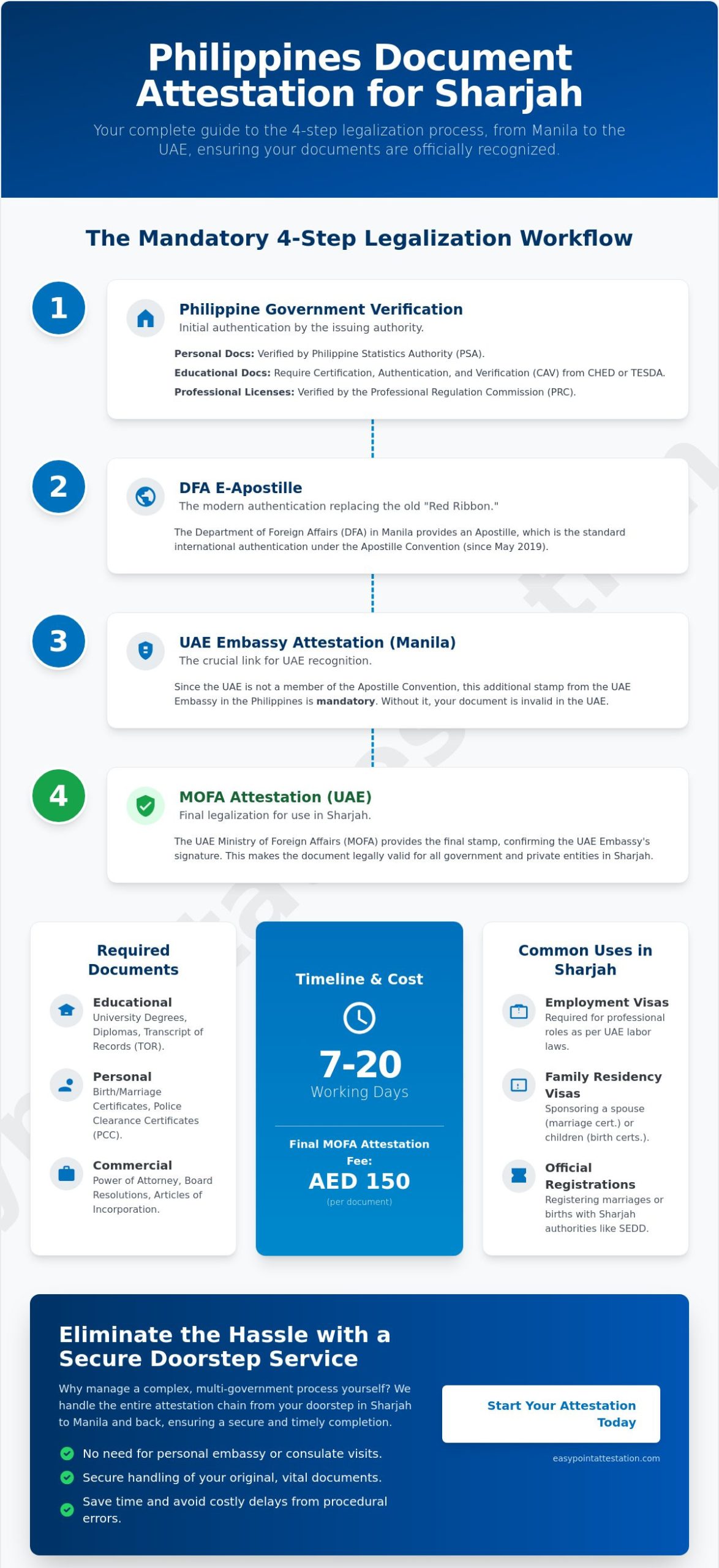
To ensure a seamless experience for Philippines document attestation Sharjah, you must prepare a specific set of credentials before starting the process. Missing a single supporting document or providing a low-quality scan can stall the entire multi-government chain. Easy Point Attestation Services requires these items to begin your end-to-end solution:
The total duration for completing Philippines document attestation Sharjah depends on the processing speed you select in Manila. Since the launch of the e-Apostille system in March 2026, digital verifications have significantly reduced waiting times. Regular DFA processing in the Philippines currently takes 5 working days, while expedited requests are released after 2 working days. The e-Apostille is the fastest option, often processed within 1 working day.
Once the DFA step is complete, the document moves to the UAE Embassy in Manila, which takes between 5 to 7 working days. After the document arrives in the UAE, the final Ministry of Foreign Affairs (MOFA) stamp requires 1 to 3 working days for courier-based submissions. Generally, you should plan for a total end-to-end timeline of 7 to 20 working days from the initial Sharjah pick-up to the final delivery at your doorstep.
Government fees are fixed and must be paid at each stage of the legalization chain. In the Philippines, the DFA charges PHP 100 for regular processing and PHP 200 for expedited services. The UAE Embassy in Manila requires a fee of AED 150 per document to validate the DFA seal. For the final step within the Emirates, the UAE Ministry of Foreign Affairs (MOFA) charges AED 150 per document. If your specific case requires the involvement of the Philippine Consulate in Dubai, their attestation fee is AED 100.
Administrative and courier costs can vary based on the document type. For example, a Degree Certificate Attestation often involves higher logistical costs than personal certificates because it requires prior verification from the Commission on Higher Education (CHED) before the DFA will accept it. Easy Point Attestation Services provides a transparent breakdown of these costs during your initial consultation to ensure there are no hidden surprises.
Even with a clear roadmap, the path to successful Philippines document attestation Sharjah often encounters administrative roadblocks. Minor errors that seem insignificant can lead to a complete halt in the legalization chain. Understanding these challenges before you submit your certificates allows you to address them proactively, saving weeks of potential delays. Our experience shows that most rejections occur due to easily avoidable mistakes in the early stages of the process.
Name discrepancies are a frequent hurdle. If the name on your PSA birth certificate doesn’t match your passport exactly, even by a single middle initial, Sharjah authorities may reject the document. Similarly, the transition from the old Red Ribbon authentication to the modern DFA Apostille system still causes confusion. In 2026, the Red Ribbon is obsolete; using an outdated authentication format will result in your document being turned back at the UAE Embassy stage. Physical condition also matters. Laminated documents pose a physical barrier because officials can’t apply the necessary wet seals or security stickers to the original paper. If your document is laminated or severely damaged, you’ll need to secure a fresh original from the PSA or CHED first.
The highest risk occurs at the final Ministry of Foreign Affairs (MOFA) stage in the UAE. Rejection here is usually the result of an incomplete chain of signatures. If the UAE Embassy in Manila missed a specific verification, or if the DFA seal is illegible, MOFA won’t grant the final stamp. This forces you to restart the entire international process from the beginning.
If your PSA birth certificate contains spelling errors, you must file a petition for a Correction of Clerical Error (CCE) at the local civil registrar in the Philippines before starting the attestation. Legal translation is often required by Sharjah government departments to ensure all foreign stamps and text are accurately recorded in Arabic for local systems. Always verify that all seals are legible and correctly placed before leaving the Philippine Consulate General in Dubai. If you’re worried about potential errors, contact Easy Point Attestation Services for a professional document audit today.
Losing an original degree or marriage certificate during international transit can be a nightmare. Easy Point Attestation Services ensures your original documents are tracked through every border crossing using a secure, insured courier service that provides real-time updates. This level of oversight is essential for protecting your irreplaceable credentials. Read more about Embassy Attestation in the UAE to understand how we maintain document integrity across different jurisdictions.
Navigating the bureaucratic requirements of two different nations shouldn’t disrupt your daily life or career in Sharjah. While official government portals often suggest personal appearances or complex manual uploads, Easy Point Attestation provides a dedicated doorstep service that brings the entire process to you. We manage every logistical detail of Philippines document attestation Sharjah so you don’t have to worry about international courier risks or embassy queues. Our end-to-end solution covers every mandatory requirement from the initial DFA verification in Manila to the final MOFA stamp in the UAE.
Our team specializes in various document types, including educational degrees, professional licenses, and personal files. We offer expert Birth Certificate Attestation services, ensuring that family residency applications for your dependents proceed without administrative delays. Every client is assigned a dedicated account manager who provides real-time tracking updates. This ensures your original documents are monitored throughout their transit between Manila and Sharjah, providing the security-first approach we promise.
Residents across Al Majaz, Muwaileh, and Al Nahda choose our services because of our deep-rooted expertise in local Sharjah government requirements. We understand the specific standards set by the Sharjah Economic Development Department (SEDD) and other local bodies that differ from other Emirates. Our pricing remains transparent and competitive. We clearly outline the verified government fees, such as the AED 150 MOFA charge and the AED 100 Consulate fee, without adding hidden agent costs. With a proven track record of thousands of successful Philippine document attestations, we provide the quiet confidence you need to meet tight visa deadlines.
Securing your legal compliance is a straightforward three-step process designed for your convenience. First, submit an inquiry through our portal for a free consultation where we verify your document’s current status and check for common errors like name discrepancies. Second, once the audit is complete, we arrange a secure pickup from your home or office in Sharjah. Third, our team handles the entire processing chain across all ministries, delivering the fully attested document back to your doorstep within the 7 to 20 working day window we established in May 2026.
Contact Easy Point Attestation for a Hassle-Free Quote and take the first step toward your validly attested document today.
You now have a clear roadmap for navigating the complexities of Philippines document attestation Sharjah in 2026. From understanding the shift to the digital e-Apostille system to mastering the four-step legalisation chain from the DFA to the UAE Ministry of Foreign Affairs, you’re prepared to handle your administrative requirements with precision. Avoiding common errors like name discrepancies and ensuring your original certificates are never laminated are critical steps to prevent costly delays in your visa or employment application.
Easy Point Attestation removes the burden of bureaucracy from your shoulders by managing every cross-border detail on your behalf. We offer certified expert support for Philippine documents and maintain a 100% success rate in MOFA legalisation. Our hassle-free doorstep pickup and delivery in Sharjah ensures you never have to visit an embassy or consulate in person, saving you valuable time for your career and family.
Secure Your Seamless Attestation Service in Sharjah Today. We look forward to helping you achieve your residency and career goals with absolute legal compliance and peace of mind.
Yes, you can complete the entire legalization process without leaving the UAE. Our professional doorstep service handles the complex logistics from Manila to Sharjah on your behalf. We manage the verification at the Department of Foreign Affairs and the UAE Embassy in Manila. This end-to-end solution eliminates the need for expensive flights and time-consuming personal visits to government offices.
The end-to-end timeline for Philippines document attestation Sharjah generally spans 7 to 20 working days. Digital e-Apostilles from the DFA, launched in March 2026, take 1 working day, while regular processing takes 5 days. The UAE Embassy in Manila requires 5 to 7 days, and the final MOFA stamp in Sharjah adds another 1 to 3 working days to the total duration.
Yes, MOFA attestation is mandatory for all Philippine birth certificates used for residency or legal transactions in Sharjah. Without the final AED 150 Ministry of Foreign Affairs stamp, Sharjah government departments won’t recognize the document as valid. This final step confirms the authenticity of the previous DFA and UAE Embassy seals for local authorities like the Sharjah Police or SEDD.
DFA authentication confirms that the local Philippine official who signed your certificate had the legal authority to do so. In contrast, the UAE Embassy attestation in Manila validates the DFA’s seal specifically for use by the UAE government. Both steps are essential links in the legalization chain and can’t be skipped if you intend to use your documents for employment or sponsorship in Sharjah.
No, you can’t use a standalone Apostille for documents in the UAE. Although the Philippines joined the Hague Convention in 2019, the UAE isn’t a member of that treaty. You must follow the full legalization process. This includes DFA authentication, UAE Embassy attestation in Manila, and the final MOFA verification within the Emirates to ensure your documents are legally recognized.
Total government fees include PHP 100 to 200 for the DFA Apostille and AED 150 for the UAE Embassy in Manila. The final MOFA attestation in the UAE costs AED 150 per document. If you require the Philippine Consulate in Dubai to attest the document for Philippine-related transactions, there’s an additional fee of AED 100. These costs are separate from any courier or administrative service charges.
Laminated documents are rejected by the DFA and the UAE Embassy because officials can’t apply security stamps or wet seals to the original paper. You’ll need to request a new original certificate from the Philippine Statistics Authority or your university. Ensure the new copy remains unlaminated to allow for successful processing. We can guide you through the process of obtaining a fresh original if needed.
You don’t need to provide your physical passport for the attestation process. A clear, high-resolution color copy of the passport data page is sufficient for identity verification at the DFA and the UAE Embassy. This ensures your original travel document remains safely in your possession while we handle the legalization of your certificates. We only require the original document that needs to be attested.