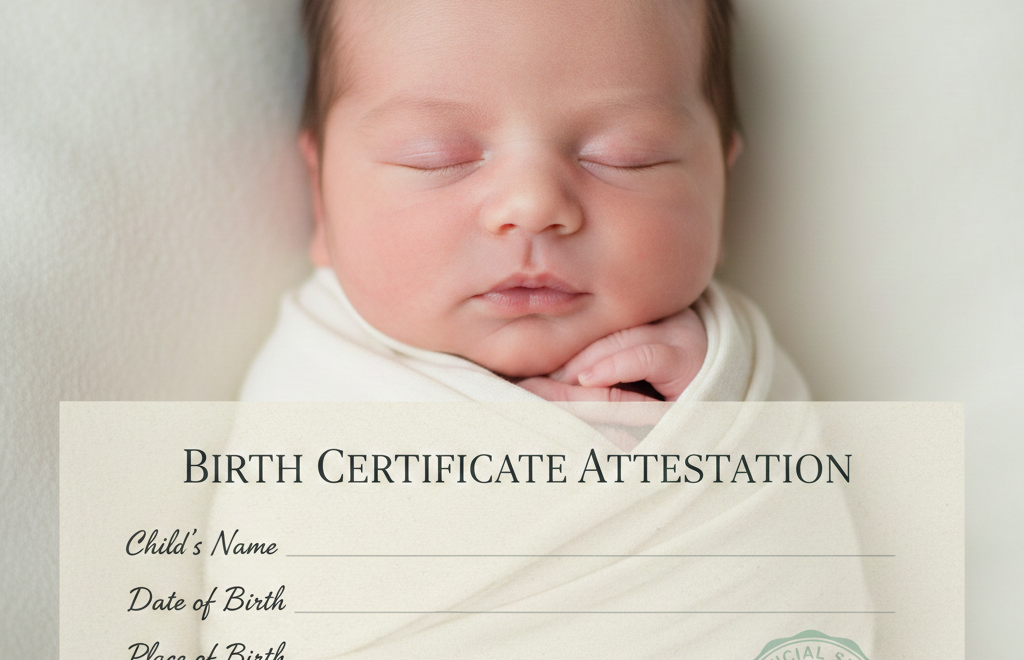
Bringing your family to live with you in the UAE is one of the most meaningful milestones in your journey abroad. Whether you have recently welcomed a newborn or are planning to sponsor your child under your UAE residence visa, one question often creates confusion:
“Do I need to get my baby’s birth certificate attested from the UAE Embassy for a UAE family visa?”
The short answer is yes — in most cases, embassy attestation is required for birth certificates.
But the full process is more detailed than many parents expect.
Many families only discover missing steps after their application is delayed or rejected. Understanding the legalization chain before submitting your documents can save time, money, and unnecessary stress.
Let’s break this down clearly.
The UAE government requires official confirmation that foreign-issued documents are genuine and legally recognized.
A birth certificate issued outside the UAE is considered a foreign document. Before it can be accepted for:
It must go through proper legalization.
The UAE does not simply accept a foreign birth certificate at face value. Authorities must verify:
Without this chain, your visa file may not move forward.
Some parents assume MOFA attestation in Dubai is enough.
It is not.
MOFA is the final step, not the first.
If embassy legalization is missing, MOFA will refuse to stamp the document. That means:
Embassy attestation confirms that your birth certificate is suitable for legal use inside the UAE system. Without it, the document is incomplete.
The legalization process follows a strict sequence. It cannot be rearranged.
Your baby’s birth certificate must first be authenticated in the country where it was issued.
Depending on the country, this may involve:
This confirms the document is genuine within that country.
Once home country attestation is completed, the document must be submitted to the UAE Embassy (or UAE Consulate) in that country.
The embassy verifies:
This step is mandatory for documents issued outside the UAE.
After embassy legalization, the document must be attested by the Ministry of Foreign Affairs in the UAE.
This is the final legalization stamp required for:
Only after this step is your baby’s birth certificate legally usable in the UAE.
If your baby was born inside the UAE, the process is different.
In this case:
However, if you plan to use that certificate outside the UAE, then legalization through MOFA and the destination country’s embassy may be required.
Even genuine documents get rejected because of small procedural errors.
Here are the most common issues:
Each mistake can cause delays of weeks.
When dealing with visa timelines, even small errors can disrupt relocation plans.
In many cases, yes.
If your baby’s birth certificate is not in Arabic, authorities may require:
Translation requirements depend on:
It is always safer to confirm before submission.
Time depends on:
On average:
Delays occur when documents are incomplete.
Proper document checking before submission avoids repetition.
The embassy stamp itself does not technically expire.
However, immigration authorities may request recently attested documents, typically:
It is always best to complete attestation close to your visa submission date.
Immigration authorities use the birth certificate to confirm:
Without proper attestation:
Attestation protects both the applicant and the UAE legal system.
Technically, yes.
But many parents face challenges such as:
Professional attestation services reduce risk and save time.
Family visa processes often follow:
Delays in attestation can affect the entire timeline.
For working parents, handling multi-country legalization alone can be overwhelming.
With proper guidance:
Instead of trial and error, the process becomes structured and predictable.
Yes.
If your baby’s birth certificate was issued outside the UAE, UAE Embassy attestation is a mandatory step in the legalization process for a UAE family visa.
It cannot be skipped.
MOFA alone is not enough.
The correct sequence must be followed for the document to be legally accepted in the UAE.
Family relocation should be joyful, not stressful.
A birth certificate may seem like a simple document, but for UAE visa purposes, it must follow a strict legalization path:
Home country authentication
UAE Embassy attestation
MOFA UAE attestation
Skipping any step can cause rejection and delay.
Instead of risking mistakes or repeated submissions, it is always safer to work with professionals who understand the process clearly.
For a fast, secure, and properly handled birth certificate attestation process, contact Easy Point Attestation Services in Dubai.
They ensure your document travels the correct path — so your family visa journey moves forward without unnecessary obstacles.
Yes, if the certificate was issued outside the UAE, embassy attestation is required before MOFA stamping.
No. The birth certificate must be legally attested to prove the parent-child relationship.
Processing usually takes 1–3 weeks depending on the issuing country and embassy timelines.
No. MOFA is the final step. Embassy legalization must be completed first.
The stamp does not expire, but immigration offices may require recently attested documents.
If the document is not in Arabic, certified translation may be required.
Yes. Authorized attestation services can handle the process on your behalf.