
On January 4, 2024, a senior engineer in Dubai faced a sudden visa rejection because a single stamp was missing from their embassy attestation UAE process. It’s a scenario that affects approximately 15% of newcomers who attempt to manage complex legalization steps alone. You likely feel the pressure of coordinating between international authorities and local ministries while your start date approaches. It’s stressful to think that one missed signature could stall your residency or employment in the Emirates.
We’ll help you master these complexities for 2026, providing a clear roadmap for document verification across Dubai, Abu Dhabi, and Sharjah. This article explains which stamps your certificates need and how to secure them without the usual bureaucratic delays. You’ll discover how a hassle-free, end-to-end solution removes the risk of error. We’ll outline the exact path to compliance and show how our doorstep service handles the legwork so you can focus on your new life in the UAE.
Embassy attestation UAE is the formal procedure of verifying the authenticity of signatures, stamps, and seals on documents issued outside the Emirates. This process acts as a mandatory chain of authentication. It ensures that foreign documents are legally recognized by UAE government bodies, including the Ministry of Human Resources and Emiratisation (MOHRE) and the General Directorate of Residency and Foreigners Affairs (GDRFA). Without this verification, a document remains a private paper with no legal standing in the country.
Understanding What is Embassy Attestation? helps clarify why this isn’t a single-step task. It involves a series of validations starting from the country of origin and ending with local authorities in the UAE. This procedure is essential for anyone planning to secure a residency visa, enroll in a university, or establish a business. Without these specific stamps, your documents lack the legal weight required for official use. The process effectively bridges the gap between different national legal systems.
Document types generally fall into three distinct categories:
Many applicants confuse notarization with the full attestation process. A local notary public only verifies the identity of the person signing a document within their own country. While this is often the first step, a notary stamp alone isn’t enough for international use. UAE immigration departments will reject documents that haven’t moved beyond this initial stage. Attestation is a higher-level government verification that confirms the notary’s own authority, making the document valid for cross-border legal matters. It’s a secure way to prevent fraud in international dealings.
The UAE isn’t a member of the 1961 Hague Apostille Convention. This means the simplified apostille process used in many Western countries doesn’t apply here. Instead, you must complete a full, multi-tiered attestation chain. This sequence concludes with MOFA attestation in the UAE. This final validation by the Ministry of Foreign Affairs is the definitive proof of a document’s legitimacy. Our team provides an end-to-end solution to manage this complex framework, ensuring your paperwork meets every regulatory standard without delay.
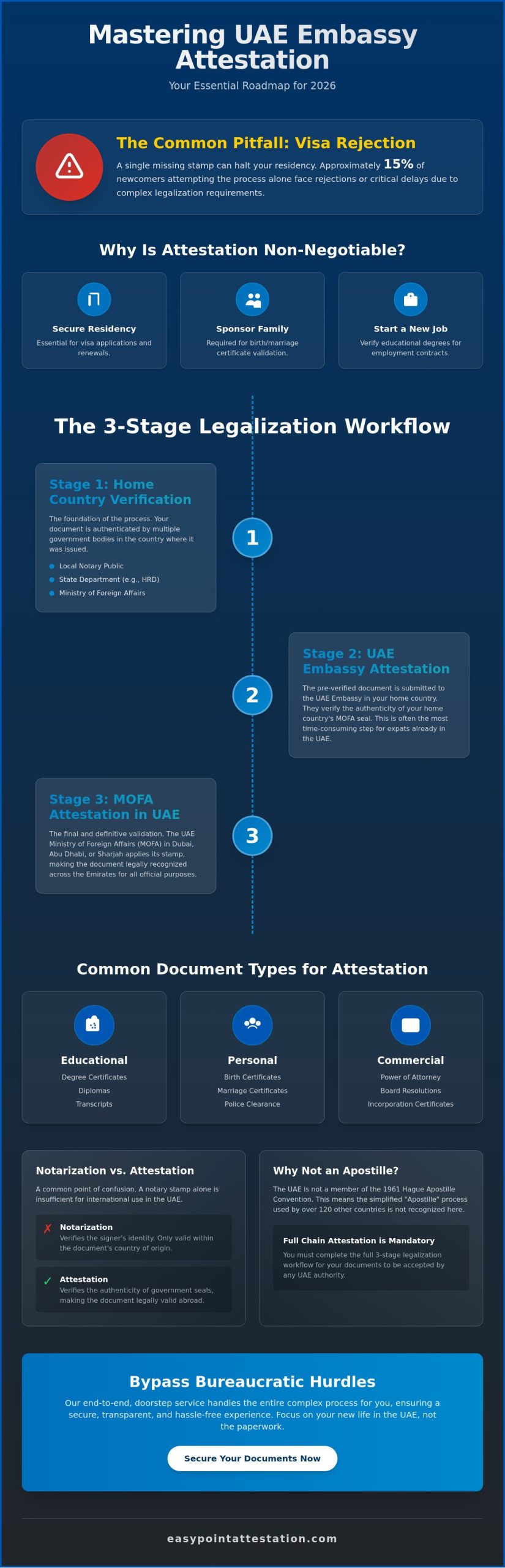
The process for embassy attestation UAE follows a strict, non-negotiable sequence. You must complete three distinct phases to ensure your educational, personal, or commercial documents are legally recognized within the Emirates. Skipping a single step or attempting to bypass a specific department renders the document invalid for official use by government entities like the Ministry of Human Resources and Emiratisation (MOHRE). If your original documents aren’t in Arabic, you’ll also need a legal translation from a certified professional before the final stages can be completed.
Before any international verification can occur, your document must be authenticated by local authorities where it was issued. This usually begins with a local notary public followed by state-level departments, such as the Human Resource Development (HRD) department for educational certificates or the Home Department for personal documents like birth certificates. Once these local stamps are secured, the document travels to the home country’s Ministry of Foreign Affairs for a national-level seal. Home Country Verification is the foundation of the entire process. Without this initial layer of trust, the UAE Embassy cannot proceed with their verification.
The second phase involves submitting the pre-verified document to the UAE Embassy or Consulate located in your home country. It’s vital to understand that the embassy verifies the authenticity of the home country’s MOFA seal rather than the specific content of the document itself. For expats already residing in Dubai or Abu Dhabi, this phase often proves to be the most time-consuming. It requires sending physical documents back across borders, which involves logistical risks and potential delays in processing times. Professional services often handle this international transit to maintain document security.
The final step occurs once the document arrives in the Emirates. You must obtain a stamp from the official UAE attestation portal or a physical MOFA customer happiness center. This final seal “activates” your document, making it legally binding for use with UAE government departments, banks, and employers. Easy Point Attestation manages this entire transit process, ensuring your documents move securely through each international checkpoint. If you’re feeling overwhelmed by these requirements, you can contact our experts to handle the logistics on your behalf.
Holding a physical degree or marriage certificate is only the first step in your relocation journey. The UAE government requires sovereign proof that these documents are genuine before they can be used for official purposes. This is where embassy attestation UAE becomes a mandatory legal bridge. Many expatriates mistakenly assume original papers are sufficient; however, without the correct sequence of stamps, these documents hold no legal weight within the Emirates. The UAE isn’t a member of the Hague Apostille Convention, meaning every document must go through a specific, multi-step legalization chain to be recognized as valid.
Attempting a DIY approach often leads to document loss or rejection due to incorrect seal sequences. For example, skipping the home country’s Ministry of Foreign Affairs before visiting the UAE Embassy will result in an immediate rejection at the MOFA office in Dubai or Abu Dhabi. This delay can cost thousands of dirhams in fines or missed employment start dates. Professional attestation ensures your professional title matches your actual qualifications. Without an attested degree, you might be restricted to a “clerk” designation on your visa, which directly impacts your salary bracket and eligibility for the 10-year Golden Visa.
The Ministry of Human Resources and Emiratisation (MOHRE) mandates attested educational certificates for all skilled professional roles categorized under Skill Levels 1 to 3. If your degree isn’t verified, you won’t be able to secure a managerial or specialist visa title. Family stability also relies on this process. You’ll need Birth Certificate Attestation to secure residency for your children and enroll them in UAE schools. Similarly, sponsoring a spouse in Dubai or Abu Dhabi requires an attested marriage certificate to prove the legal relationship to the General Directorate of Residency and Foreigners Affairs (GDRFA). For US citizens, Navigating Attestation in Dubai requires following the strict chain authentication process starting at the state level before moving to federal departments.
Entrepreneurs must legalize Board Resolutions and Power of Attorney (POA) documents to register a new entity or open a branch office. UAE banks, including Emirates NBD and ADCB, won’t initiate corporate account opening or KYC procedures without seeing the specific embassy stamps on trade licenses and commercial invoices. This embassy attestation UAE process protects your corporate legal interests and ensures that contracts signed within the country are enforceable. Without these verified documents, a business cannot legally hire staff, lease commercial office space, or participate in government tenders. If your business dealings involve biometric verification documents, understanding the full fingerprint attestation UAE process is equally critical to avoid costly contract delays.
The physical landscape of embassy attestation UAE requires a clear understanding of where specific government bodies reside. Most administrative procedures happen across three main hubs: Dubai, Abu Dhabi, and Sharjah. Each city plays a distinct role in the document legalization chain. While the Ministry of Foreign Affairs (MOFA) has offices in multiple locations, the actual foreign embassies and consulates are concentrated in specific zones. This geographic split means a single document might need to travel through multiple cities before it’s legally valid for use.
Logistics remain the biggest hurdle for residents. Driving from Dubai to Abu Dhabi for a single stamp can consume four hours of your day; you have to factor in the E11 traffic and security checks at embassy gates. Sharjah residents face similar constraints. They often need to visit Dubai-based consulates for specific country requirements after completing local Sharjah-level attestations. These administrative hurdles often lead to delays in visa processing or employment start dates if you don’t plan the route perfectly.
Most foreign consulates are situated in the Bur Dubai or Al Qusais areas. These offices handle routine document legalization for their respective citizens and residents. However, Abu Dhabi remains the primary seat for all major Embassies. If your document requires a high-level diplomatic signature, inter-city travel is mandatory. Sharjah residents typically utilize Tasheel centers for initial state-level verifications, but they must eventually coordinate with Dubai or Abu Dhabi offices for the final embassy attestation UAE stages. Each office has its own unique submission window, often limited to just two hours per day.
Professional agencies offer a “Hassle-Free” solution that eliminates the need for personal travel. Our doorstep service ensures that your sensitive documents are collected directly from your home or office in any Emirate. We use secure, tracked couriers to move certificates between the Ministry in Dubai and the Embassies in Abu Dhabi. This end-to-end solution protects your original papers while you focus on your professional responsibilities. It’s the most efficient way to handle complex paperwork without leaving your desk.
By using a specialized service, you bypass the long queues and varying submission timings of different government offices. Different consulates have specific rules for document drop-off and collection that can change without notice. A professional partner manages these tight schedules on your behalf, ensuring every stamp is obtained in the correct sequence. To save time and ensure your papers are handled correctly, you should contact a specialist to manage the entire logistical chain.
Navigating embassy attestation UAE requires a partner who understands the nuances of 2026 administrative shifts. Easy Point Attestation acts as your expert guide for all attestation services. We manage the entire lifecycle of your document, from initial notarization to the final Ministry of Foreign Affairs stamp. Our team focuses on three core pillars: transparency, speed, and comprehensive management. We provide a convenient doorstep service, collecting your papers and returning them once they’re fully legalized. We know that documents like degree certificates and marriage licenses are highly sensitive. That’s why we use secure handling procedures to protect your data throughout the transit process. You won’t have to worry about lost paperwork or missed steps during the verification cycle.
Our agency manages the full verification chain, including the essential home country leg in nations such as India, the UK, the Philippines, or the USA. We coordinate directly with foreign ministries and embassies to secure the necessary stamps before the document even reaches the UAE. For businesses, we handle complex corporate documents like Memorandums of Association and Board Resolutions with precision. To meet local requirements, we offer legal translation services that comply with Ministry of Justice standards. This is vital for non-Arabic documents intended for court or government use. Every client receives access to real-time tracking. You’ll get updates at every milestone, ensuring you’re never left wondering about your application’s status.
Timing is critical when you’re preparing for a new job or setting up a branch office in the Emirates. Starting the process early ensures you meet your visa or licensing deadlines without the stress of last-minute rushes. We offer a clear path forward with a free consultation to assess your specific needs. This initial review helps identify potential hurdles before they cause delays. Submit your inquiry today for a personalized quote that reflects the current 2026 regulatory landscape. Our experts are ready to take the burden of bureaucracy off your shoulders. Get your hassle-free embassy attestation today with Easy Point!
Navigating the administrative landscape of the Emirates requires precision and adherence to the latest 2026 regulations. Successful residency depends on a three-stage legalization workflow that moves from your home country to the Ministry of Foreign Affairs (MOFA). This process ensures your educational, personal, or commercial documents meet the strict legal standards required for employment and family visas. Managing embassy attestation UAE requirements on your own often leads to delays that impact your career or relocation timeline.
Easy Point Attestation provides an end-to-end solution for expats and businesses. Our team manages the complex MOFA and Embassy workflows with the authority of a seasoned professional. We’ve earned the trust of thousands of individuals who require secure document handling to meet government mandates. You can rely on our secure doorstep collection and delivery services across Dubai, Abu Dhabi, and Sharjah to save time. We handle the bureaucracy so you don’t have to worry about the paperwork.
Start your hassle-free document attestation with Easy Point today!
Your journey to a successful life in the Emirates starts with verified documents, and we’re ready to ensure your transition is seamless.
The embassy attestation UAE process typically requires 7 to 15 working days to complete. This timeframe depends on the specific requirements of the issuing country’s consulate and the document type. For example, educational certificates often take 10 days while commercial documents might be finalized in 5 days. We provide a streamlined timeline to ensure you meet your visa or business deadlines without delay.
You can manage the attestation process yourself, but most individuals choose a professional agency to avoid administrative errors. Navigating various government departments and foreign embassies requires significant time and precise knowledge of current regulations. Our end-to-end solution handles every step from notarization to the final stamp. This approach eliminates the risk of rejection and saves you multiple trips to government offices.
If an embassy rejects your document, you must restart the application process and pay the processing fees again. Rejections often happen because of missing prior certifications or incorrect document formatting. We review every certificate before submission to ensure it meets the 100% compliance standards required by UAE authorities. Our team identifies potential issues early to prevent costly delays in your application.
Yes, MOFA attestation and embassy attestation are distinct but sequential steps in the legalization chain. Embassy attestation confirms the document’s validity for use in a specific foreign country, while the Ministry of Foreign Affairs (MOFA) provides the final local verification. You generally need the embassy stamp before MOFA will provide the final UAE validation. This two-step verification ensures your documents are legally recognized across international borders.
You don’t always need an Arabic translation for the initial embassy attestation UAE steps if the document is in English. However, the UAE Ministry of Justice requires a legal Arabic translation for specific local government submissions or labor contracts. We recommend checking the specific requirements of your employer or the relevant department. Our team provides certified translation services to ensure your documents meet all legal standards simultaneously.
Typical fees for embassy attestation in Dubai vary based on the document type and the specific embassy’s tariff. For example, the UAE Ministry of Foreign Affairs charges a standard fee of AED 160 for personal documents and AED 2,000 for commercial invoices as of 2024. Embassy charges are additional and fluctuate based on exchange rates and specific consular policies. We provide a transparent breakdown of all official costs before starting your application.
You can use old attestation stamps for educational degrees because these documents don’t expire. However, documents like police clearance certificates or power of attorney papers often have a validity period of 6 months to one year. If you’re applying for a new visa in 2026, you must ensure your specific document remains legally valid under current UAE Ministry of Human Resources and Emiratisation guidelines.
Attesting a Power of Attorney for a Sharjah business requires notarization by the Sharjah Courts first. Following this, the document must be verified by the Ministry of Foreign Affairs and then the relevant foreign embassy. This process ensures the document is legally binding for commercial activities or property transactions. Our doorstep service handles the logistics between Sharjah and the various diplomatic missions located in Dubai or Abu Dhabi.
The complete process for degree certificate attestation UAE involves notarization in the country of origin, followed by state-level HRD verification, home country MOFA authentication, UAE Embassy stamping, and final MOFA attestation within the Emirates. Each stage must be completed in the correct sequence to ensure your educational credentials are legally recognized for employment and residency purposes. Missing any single step will result in rejection by UAE authorities. Our team manages this entire multi-country workflow on your behalf to ensure full compliance with 2026 regulations.