
Last Tuesday, a Dubai-based investor saw a commercial property acquisition worth 5,000,000 AED stall indefinitely because a single stamp was missing from their legal paperwork. It’s a common scenario that highlights how easily a minor administrative oversight can derail high-stakes deals. You likely already know that the multi-country chain for power of attorney attestation UAE is notoriously complex. Managing requirements across different jurisdictions while fearing rejection due to translation errors is enough to overwhelm any professional.
We’re here to ensure your documents are legally valid and accepted by every UAE government entity without the usual stress. This guide provides an expert step-by-step roadmap to mastering the attestation process in Dubai, Abu Dhabi, and Sharjah. We’ll walk you through the essential stages of notarization, MoFA legalization, and legal translation so you can secure your business interests with quiet confidence. You’ll gain a clear understanding of current 2026 timelines and procedures; this allows you to bypass the bureaucratic red tape and focus on your objectives.
Power of attorney attestation UAE is the mandatory verification process where the Ministry of Foreign Affairs (MOFA) confirms the authenticity of signatures and seals on a legal document. It’s the essential bridge between a private agreement and legal recognition by government authorities. Without this official stamp, a document remains a private paper with no standing in UAE courts or departments. The UAE government requires this level of scrutiny for both personal and commercial legal actions to prevent fraud and ensure that the person granting authority has the legal right to do so. To build a foundation for this process, you might first ask What is a Power of Attorney? and how it functions as a legal tool for delegating authority.
The Ministry of Justice plays a vital role in validating foreign legal instruments. When a document originates outside the Emirates, it must pass through a chain of certifications before it reaches the local ministries. There’s a distinct difference between attestation for use inside the UAE versus documents intended for use abroad. For documents coming into the country, the final step is always the local MOFA office. For documents moving out of the UAE, the process involves local notarization followed by UAE MOFA and the embassy of the destination country. This structured approach ensures that every legal representative acting on your behalf is recognized by the state.
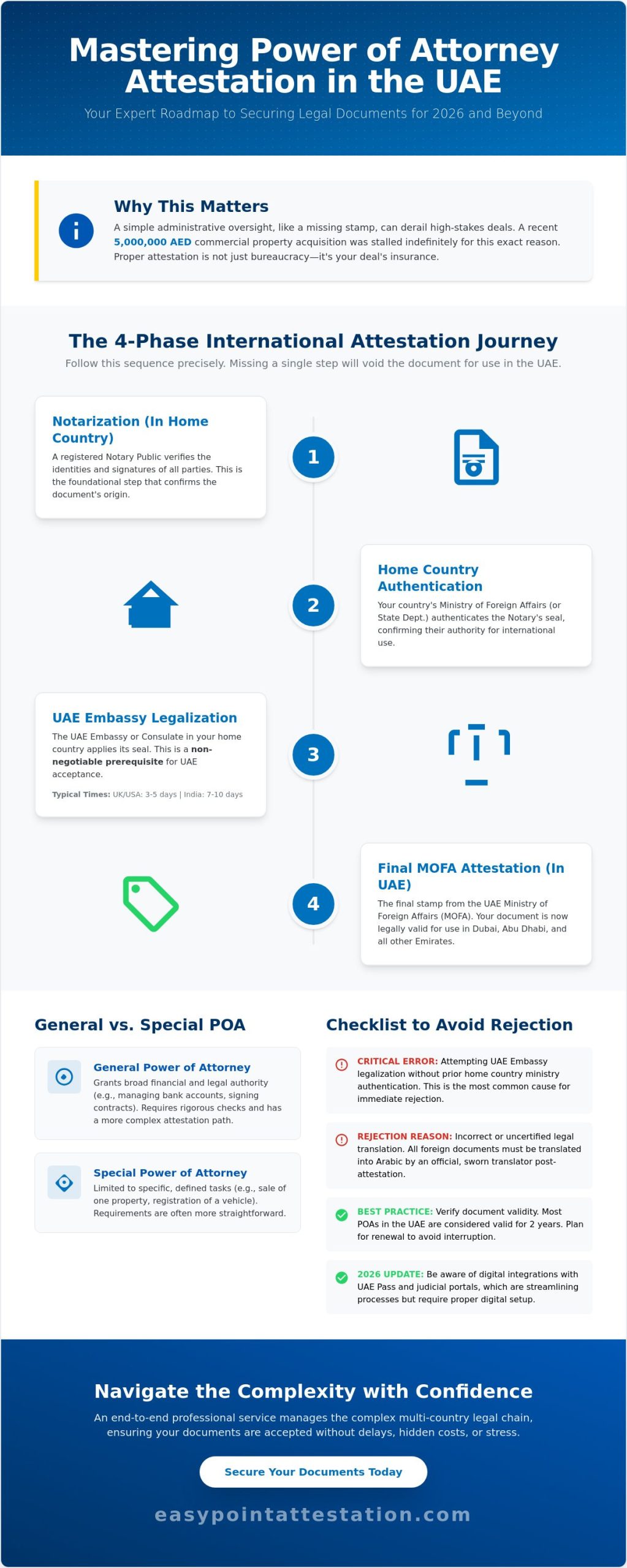
A General POA grants broad financial and legal authority to an agent, allowing them to manage bank accounts, sign contracts, and represent you in various capacities. Because the scope is so wide, the attestation path is often more complex and requires rigorous checks by legal experts. In contrast, a Special POA is limited to specific tasks, such as the sale of a particular property or the registration of a vehicle. The specific scope of authority directly impacts the MOFA attestation requirements, as certain government departments may require specific phrasing or additional approvals before they accept the document for processing.
Attested POAs aren’t permanent. In UAE courts, a typical validity period for many types of POAs is 2 years, after which the document must be renewed or re-attested. A correctly attested document is the only way to avoid a personal appearance in government offices; it allows your representative to act with full legal weight. You should be aware of the 2026 regulations regarding the revocation of attested POAs, which aim to streamline how authorities track the cancellation of authority. Staying compliant with these timelines ensures your legal representative can continue to act without sudden interruptions at a land department or economic department counter.
Validating a legal document across international borders requires a strict four-phase sequence. If you miss a single step, the entire document becomes legally void for use in the Emirates. The process for power of attorney attestation UAE begins in the country where the document was originally signed.
Phase 1 requires notarization by a registered Notary Public in your home country to verify the identities and signatures of all parties involved. Following this, Phase 2 involves authentication by your Home Country Ministry of Foreign Affairs or State Department. This step confirms the notary’s authority and is essential for international recognition. Phase 3 is the legalization at the UAE Embassy or Consulate in that same country. Finally, Phase 4 is the MOFA attestation UAE. This final local stamp confirms the document’s legitimacy for use within Dubai, Abu Dhabi, or any other emirate.
The UAE Embassy stamp is a non-negotiable prerequisite. Local MOFA officers in the Emirates won’t accept a document that lacks this specific overseas seal. In major hubs like the UK or USA, embassy processing typically takes 3 to 5 business days. In India, the process can extend to 7 or 10 days depending on the state of origin and local verification requirements. A common mistake that leads to rejection in Dubai is failing to obtain the home country’s national-level authentication before visiting the UAE Embassy. Without that prior stamp, the embassy cannot verify the document, which leads to costly delays and additional courier fees.
All foreign POAs must be translated into Arabic to be legally binding in local courts and government departments. This isn’t a standard translation. It must be completed by a translator licensed and approved by the UAE Ministry of Justice. The government is rapidly modernizing these steps. For instance, the digital power of attorney issuance service launched in September 2022 highlights the shift toward electronic integration. For foreign documents, you often face a “double-attestation” process. This means the Arabic translation itself may require a separate stamp from the Ministry of Justice to verify the translator’s credentials.
Managing these layers of bureaucracy across different time zones is exhausting. You can find integrated translation and attestation solutions
The UAE legal landscape has undergone a significant transformation. By 2026, the shift toward digital notarization via the Dubai Courts and Abu Dhabi Judicial Department (ADJD) portals has become the standard for residents and investors. This transition relies heavily on the UAE Pass, which serves as the primary identity verification tool for all legal transactions. The system uses biometric data to confirm a user’s identity, allowing for the issuance of a “e-POA” that carries full legal weight without the need for a traditional physical ink stamp or embossed seal. This modernization has significantly reduced the time required for power of attorney attestation UAE, turning what was once a multi-day process into a matter of minutes.
While these digital advancements streamline local procedures, they don’t apply to every scenario. Foreign-issued POAs still require a physical attestation chain. Even with the internal digital trends, a document originating in London or New York must still be physically stamped by the relevant embassy and the Ministry of Foreign Affairs before it’s recognized in the UAE. Our team at Easy Point Attestation provides a secure end-to-end solution for these complex international requirements, ensuring your foreign documents are ready for the UAE’s digital systems.
Residents can now access a digital power of attorney issuance service through a structured online workflow. First, the principal logs into the Dubai Courts digital notary portal using their UAE Pass. Second, they select the appropriate legal template and enter the agent’s details. Third, the system schedules a brief video conference with a notary public to verify the principal’s identity and intent. Once approved, the e-POA is issued instantly with a verifiable QR code. This digital document is automatically recognized in other Emirates like Sharjah or Ajman, as the federal UAE Pass system bridges the jurisdictional gap between local courts.
The Ministry of Foreign Affairs (MOFA) has optimized its smart application to handle digital document verification with high efficiency. Users upload high-resolution scans of their notarized documents and pay the official government fees through the integrated gateway. This remote process is ideal for documents that have already cleared the initial stages of legalization. However, there are limits to this digital workflow. Documents issued by non-Apostille countries often face stricter scrutiny and may require physical verification at a MOFA service center. If you’re managing documents from multiple jurisdictions, our MOFA attestation experts can handle the physical submissions to ensure your power of attorney attestation UAE is completed without technical delays or rejections.
Successful power of attorney attestation UAE depends on the precision of your documentation. Government authorities maintain strict standards for legal paperwork; even a minor smudge or a missing photocopy can halt the entire process. To ensure your application moves through the system without delays, you must prepare a complete document package before visiting the Notary Public or Ministry of Foreign Affairs (MOFA).
The standard checklist for a POA application includes:
Legal officers reject a significant number of applications due to avoidable administrative errors. First, jurisdiction errors occur when a POA is drafted using templates from other countries that don’t align with UAE Civil Law. Second, signature mismatches are a frequent cause of rejection. Your signature on the POA must match your passport signature exactly; any variation will lead to an immediate decline. Finally, keep an eye on the calendar. MOFA often rejects notarizations or stamps that are older than 180 days. If your document was notarized over six months ago, you’ll likely need a fresh notarization before proceeding with the power of attorney attestation UAE.
While federal laws apply across the Emirates, local departments often have unique procedural nuances. In Sharjah, the Notary Public offices perform rigorous verification for commercial POAs. They frequently require the physical presence of all parties or specific verification from the Sharjah Economic Development Department (SEDD) if the POA involves local business shares.
In Abu Dhabi, property-related transactions are managed with extra scrutiny. The Abu Dhabi Judicial Department (ADJD) requires specific digital or physical stamps for any POA used to buy or sell real estate within the capital. If you plan to use a document across multiple Emirates, it’s best to have it attested by the federal Ministry of Justice to ensure its validity from Dubai to Fujairah. This centralized approach prevents the need for repetitive local attestations.
Navigating the complex requirements for power of attorney attestation UAE demands precision and a deep understanding of international law. Easy Point Attestation Services acts as the expert bridge between foreign embassies and UAE ministries, ensuring your legal documents meet every regulatory standard. We manage the entire end-to-end legalization chain. This process often involves multiple steps across different jurisdictions, including notarization in the country of origin, attestation at the relevant Ministry of Foreign Affairs abroad, and final legalization by the UAE Embassy in that country.
Our local presence in Dubai, Abu Dhabi, and Sharjah allows us to fast-track applications that might otherwise take weeks. We handle the government red tape so you don’t have to. By choosing our services, you eliminate the need to visit multiple government offices or wait in long queues at the Ministry of Foreign Affairs (MOFA). Our team understands the specific nuances of UAE administrative procedures, which helps prevent document rejection and unnecessary delays. We provide a reliable, streamlined path to document validity.
We understand that your time is a valuable asset. Easy Point Attestation Services offers a secure document collection and delivery service that spans the entire UAE. Whether you’re located in a high-rise in Dubai Marina or a corporate office in Abu Dhabi, our couriers reach you directly. We implement rigorous security protocols to handle sensitive legal documents like POAs. This includes using tamper-evident transit bags and maintaining a verified chain-of-custody log for every document handled.
This doorstep service is the preferred choice for 85% of our professional clients and business owners. It allows you to remain focused on your core operations while we manage the logistical complexities. You won’t need to leave your desk to ensure your legal paperwork is in order. We provide real-time updates on your document’s status, giving you peace of mind throughout the entire processing cycle.
The requirements for power of attorney attestation UAE can vary significantly depending on the document’s country of origin and its intended use. We invite you to contact our specialists for a free document review. Our experts will examine your POA to ensure it meets the specific criteria set by UAE authorities before we begin the formal process. This proactive approach saves you time and prevents the cost of re-processing documents that were incorrectly prepared.
We offer transparent, upfront quotes that encompass the full scope of work, including attestation fees and any required legal translation into Arabic. Our team ensures that every translation is certified and accepted by UAE courts and government entities. To begin your seamless legalization journey, Contact Easy Point Attestation Services today. Let our seasoned professionals take the burden of paperwork off your shoulders and deliver your attested documents directly to your door.
Navigating legal requirements in 2026 requires absolute precision, especially with the full integration of UAE Pass for digital mandates. You’ve learned that successful power of attorney attestation UAE hinges on meeting exact Ministry of Foreign Affairs (MOFA) standards and ensuring all foreign documents undergo certified legal translation. Avoiding common rejection reasons like incorrect jurisdiction or expired notarization saves you time and prevents unnecessary administrative delays. Easy Point Attestation simplifies this entire process by managing every technical detail on your behalf.
Our team handles direct coordination with Dubai Courts and MOFA, ensuring your documents comply with the latest 2026 regulatory updates. We provide secure doorstep document collection across Dubai and Abu Dhabi, so you don’t have to navigate busy government offices yourself. Every workflow includes certified legal translation as a standard feature to guarantee your documents are accepted by local authorities without friction. You can trust our experts to manage the paperwork while you focus on your personal or business priorities.
Secure Your Power of Attorney Attestation Today
Standard power of attorney attestation UAE typically takes between 2 and 5 business days to complete. This timeframe accounts for the verification steps at the Ministry of Foreign Affairs (MOFA) and any necessary embassy coordination. If you’re facing a tight deadline, our team can often facilitate an expedited service that clears the local UAE portion of the process within 24 hours.
You can attest a Power of Attorney while residing abroad by following a structured international legalization chain. You’ll first need to have the document notarized and attested by the foreign ministry in your current country. Once the UAE Embassy in that country applies its stamp, the document is couriered to the UAE for the final MOFA attestation to make it legally binding.
The Ministry of Foreign Affairs (MOFA) currently mandates a fixed fee of 150 AED for the attestation of a personal Power of Attorney. For commercial or corporate POAs, the government fee is 2,000 AED per document. These official rates are set by the UAE government, though your total investment will include additional costs for courier services and any required legal translations.
You must obtain a legal translation if your Power of Attorney is drafted in any language other than Arabic. The UAE Ministry of Justice requires that a licensed translator, registered with the government, performs this task. This ensures that every clause is accurately reflected for local authorities, as most government departments and courts only accept documents presented in the official language of the state.
An Apostille is not sufficient for a Power of Attorney to be recognized in the UAE. Since the UAE isn’t a member of the Hague Apostille Convention, all documents require full legalization. This means your document needs a series of stamps, culminating in a final verification from the UAE Ministry of Foreign Affairs, rather than a single Apostille certificate.
Digital Power of Attorney documents are legally valid for property transactions in Abu Dhabi through the Abu Dhabi Judicial Department (ADJD) digital platform. You’ll need a verified UAE Pass account to sign and process these documents electronically. This modern system has streamlined real estate dealings, allowing owners to grant specific powers without needing to visit a notary public in person.
If MOFA rejects your power of attorney attestation UAE, they’ll provide a specific reason, such as a missing prior stamp or an unauthorized translation. We’ll immediately analyze the rejection notice to identify the technical error and correct the paperwork. This usually involves returning to the previous step in the legalization chain to secure the correct signature before we resubmit the document for approval.